
"Have I Reached the Party to Whom I Am Speaking?" Probably Not.
That phone number at the top of your Google search results may not belong to the company you're trying to reach. A scammer posing as a major cruise line quoted a first-time cruiser fees that were more than three times what she actually owed. The math gave it away. Sometimes it doesn't.
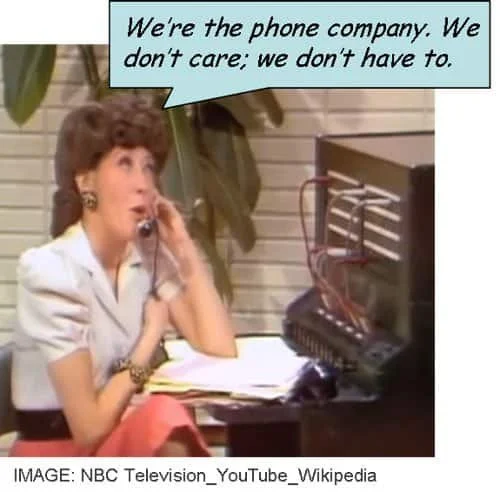
Ernestine knew she had you. So does the guy who answered on the first ring.
We've all been there. Need a phone number — one you know you probably have somewhere — but you Google it instead. The first result looks right, so you dial.
Your first clue that something's off is that a real person picks up right away. No menus to maneuver. No hold music. Just a friendly voice, ready to help.
That should have been the red flag.
A first-time cruiser — MSC in this case, but it could have been any cruise line or travel provider — posted in a Facebook group last week. Her booking was paid in full. She'd checked the app and knew gratuities ran $16 per day, per person. Then she called what she thought was MSC's customer service line, and someone told her gratuities were $400 per person — but she could prepay at half price, $200, if she acted now.
She was confused. The math didn't add up.
It didn't add up because it was invented.
The app was right. At $16 per day for an eight-day sailing, two passengers owe $256 total — not $400 each. The scammer's discounted price was still more than three times the actual cost. She caught it because she'd done her homework. A lot of people haven't, and I've seen what happens when the numbers are murkier. Those stories don't end with a Facebook post asking for clarification.
What she actually called
She didn't call MSC. She Googled a phone number, and the first result — marked "Sponsored" — belonged to a fraudulent call center.
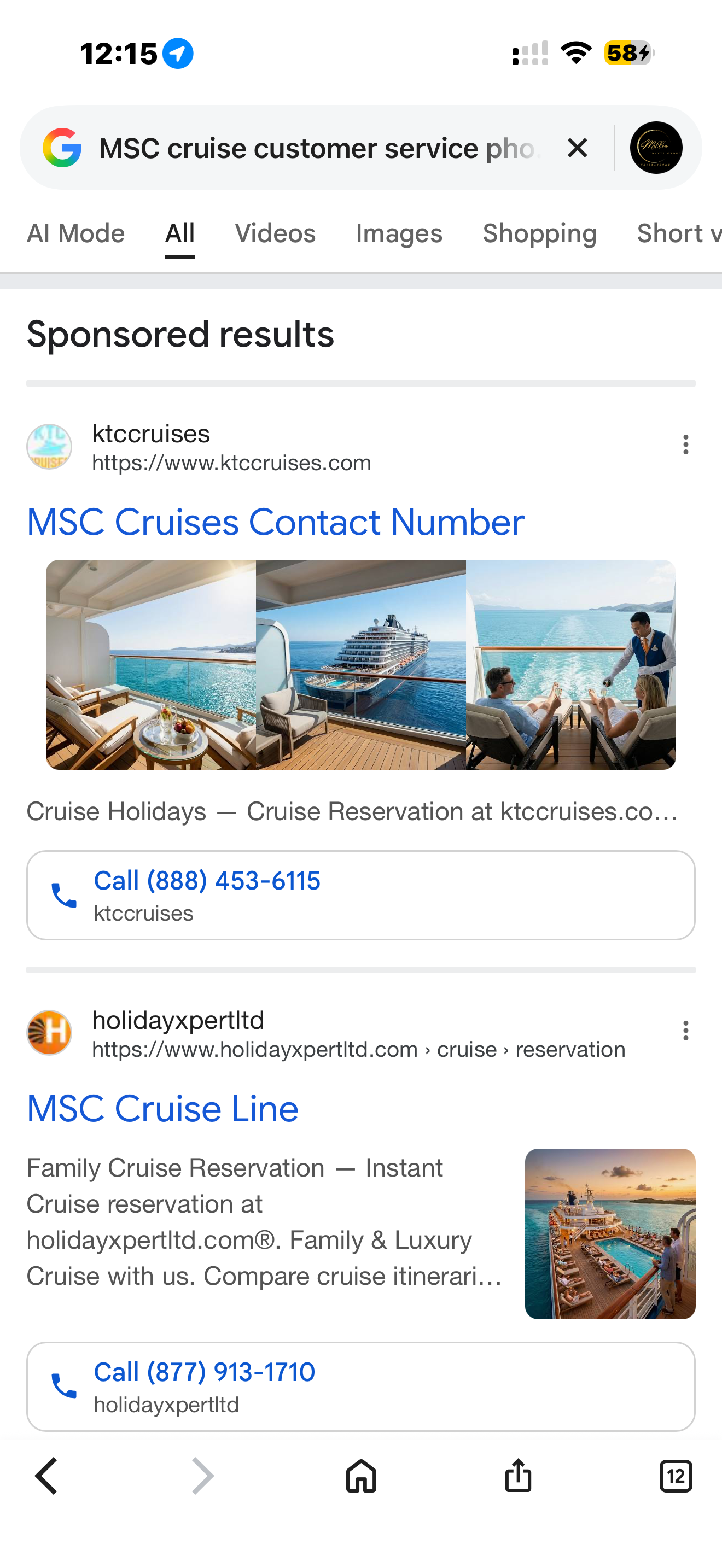
A Google search for "MSC cruise customer service phone number." Neither ktccruises.com nor holidayxpertltd.com is MSC Cruises. Both are paying to appear first when you search for MSC's phone number.
This is not a new trick. Scammers pay Google to place ads at the top of search results that look exactly like the real thing. Same logo. Similar URL. A phone number that routes to someone whose entire job is to create urgency and collect a credit card number before you think too hard about it.
The travel industry gets hit harder than most. Cruise lines, airlines, hotels — anyone with a large customer base that regularly needs to call support. These operations are sophisticated. They answer quickly, they ask for your confirmation number, they sound authoritative. The invented problem or the too-good discount comes a few minutes in, once they've established enough trust to make the ask feel reasonable.
The math is not always this obvious
This particular scammer got greedy. Quoting $400 per person when the app clearly shows $16 per day is the kind of mistake that gets caught. But I've seen cases where the numbers were close enough to plausible — a fee that could exist, a charge that sounded like something a cruise line might actually do. Those are the ones where people pay.
The scam works because most travelers don't have the rate sheets memorized. Why would they? You book a cruise once or twice a year. You don't know what gratuities run on MSC versus Celebrity versus Royal Caribbean. That gap is exactly what these operations exploit.
Three things that eliminate the risk
First: if you have the app and you're logged in, use the contact information inside it. That number is verified. The one Google surfaces first is not.
Second: when you search for anything travel-related, skip the top two to four results. Anything labeled "Sponsored" or "Ad" is paid placement. Scroll to the organic results — the actual cruise line website — and navigate from there.
Third: your booking confirmation has a phone number on it. That document came directly from the supplier. Use it.
One more general rule worth keeping: no legitimate cruise line will offer you a significant percentage discount on gratuities over the phone under time pressure. Some lines let you lock in the current rate before a price increase, which can save a dollar or two per day. Nobody is cutting your service charges in half because you called today.
If someone pressures you to pay immediately to secure a deal or avoid a problem with your booking, hang up. Log into your account directly and check your reservation. Everything will be fine, because the problem they described doesn't exist.
The easier answer
As advisors, we maintain direct lines to most major suppliers. When a client has a question or an issue, they call or text me — not a search result. I reach the right person through a channel that was never going to be compromised by a sponsored ad.
Do you need a travel advisor to protect yourself from this? No. The three rules above will do it. But this is one of those problems that simply doesn't exist for my clients, and I think that's worth saying plainly.
Billy Miller | Miller Travel Group billy@millertravelgroup.com | (817) 386-7086

Billy Miller is the founder of Miller Travel Group. He believes true vacation planning requires real human relationships and actual local expertise—which is exactly why he is rarely found sitting at home. He writes about premium travel, cruise industry realities, and destination hidden gems from a deeply personal, experiential perspective.